More on Well Chlorination

It’s key you know the specific chemistry when disinfecting a well system.
By Edd Schofield
My last column in the August 2026 issue of Water Well Journal, “The Misunderstandings of Chlorine in Well Disinfection” outlined techniques and procedures designed to improve the effectiveness of well disinfection—some of which, at first glance, may have seemed counter-intuitive.
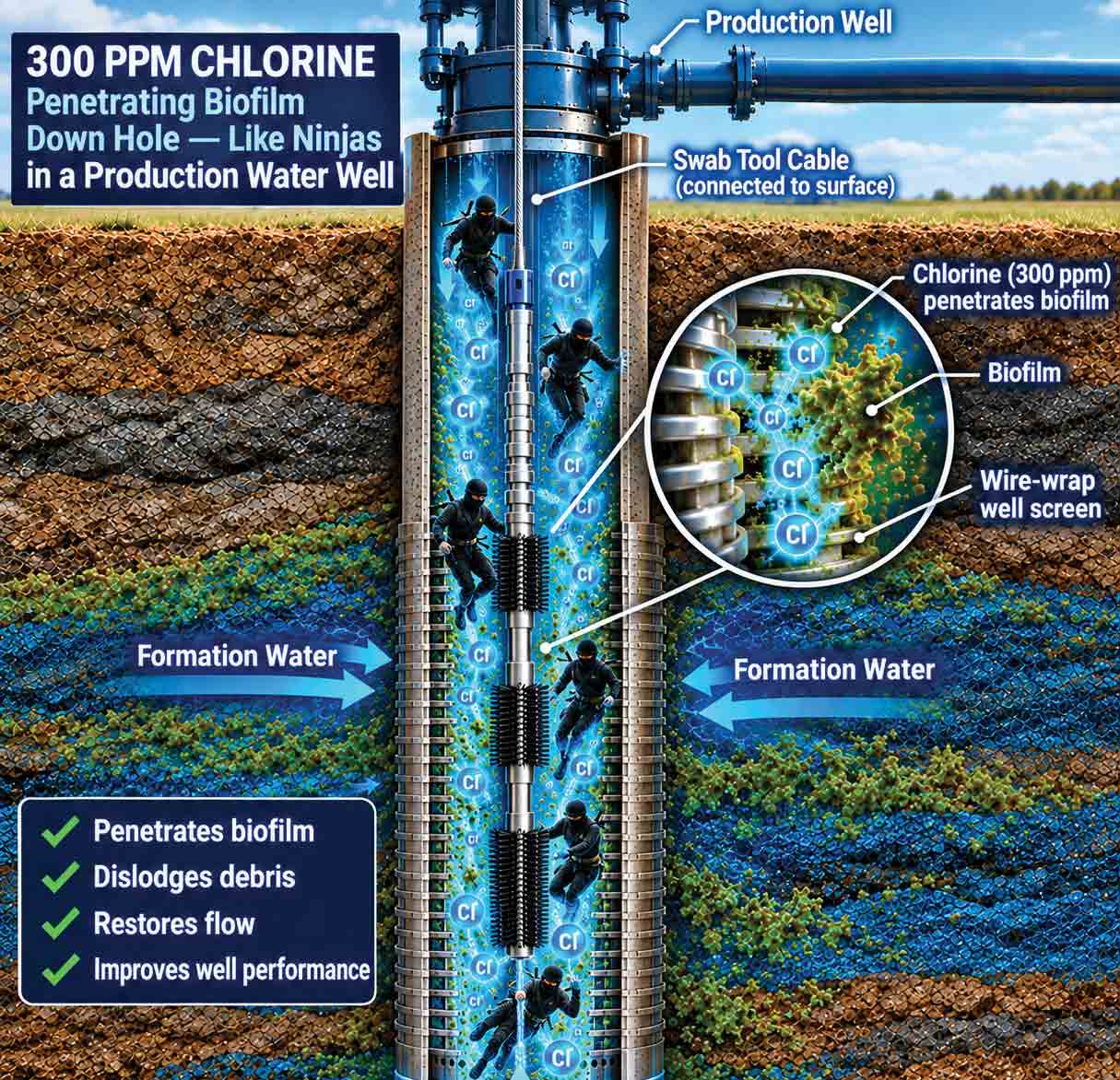
The ninja-like advantages of using chlorine at 300 ppm rather than a bomb of 1000 ppm.
It encouraged readers to reconsider the traditional approach of super chlorination or “shock” chlorination and instead consider using lower, more controlled chlorine concentrations, generally in the range of 100 to 300 parts per million (ppm). Shock chlorination levels of 1000 to 3000 ppm do not get the job done fully and often require follow-up treatment to pass regulatory tests.
Numerous studies all point to the fact that “shocking” a well does not promise guaranteed results. In fact, shock chlorination can often make the situation an even greater, more long-term problem. Super chlorination only oxidizes the outer sheath of any microorganism or bacterial colony, preventing the penetration of the entire biofilm.
The fact is lower concentrations of chlorine are more effective than shocking the well, contrary to the old “More is better” adage. Overwhelming evidence shows treatments using 100 to 300 ppm of chlorine is more effective in the killing of bacteria within a well system.
Yes, heavy concentrations of biofilm can consume chlorine rapidly. That is why we need to periodically sample the treatment solution downhole with a thief bailer and chlorine test strips to confirm that we still have a viable chlorine solution working downhole.
A study was done and documented in the early 2000s in Michigan by Water Systems Engineering Inc. in Ottawa, Kansas. It determined that at the 200 mg/l level there was a sufficient level of chlorine to provide a strong concentration on the second day even in wells with a high chlorine demand from heavy bacterial presence.
So, if you want to save time and greatly enhance your success rates in disinfecting a well, stop treating wells so heavy-handed with a nuclear bomb downhole. Rather, approach your next disinfection treatment as if you were introducing ninjas to the problem for a more complete and effective disinfection. See Figure 1 for an example of the benefits of using chlorine at 300 ppm.
Three Most Relevant Disinfection Products
Here is a direct comparison of the pros and cons of sodium hypochlorite, calcium hypochlorite, and the newer, improved offering of sodium dichloroisocyanurate, for potable water treatment and well disinfection. Please note in disinfecting any potable well system, you must use specific, NSF-certified forms of chlorine.
Sodium Hypochlorite (common as liquid bleach)
Commonly used in large-scale municipal water treatment and basic well disinfection due to immediate availability.
- Pros:
–Instant dispersal: Mixes instantly into water without requiring dissolution time.
–No residue: Leaves zero particulate matter or sediment behind.
–Cost-effective: Inexpensive and widely manufactured. - Cons:
–Rapid degradation: Loses strength quickly during storage and transport.
–Degradation accelerates at temperatures above 75° F.
–Requires pH adjustment to produce hypochlorous acid, the biocidal agent of chlorine.
–High shipping costs: Heavy bulk liquids are expensive to transport.
–Corrosive fumes: Off-gases corrosive chlorine vapors in closed environments.
–Avoid household bleaches that are scented or “splashless” formulas as these add additional chemicals into the system.
Calcium Hypochlorite (Cal-Hypo tablets)
A highly concentrated dry chlorine option popular for water wells, industrial tanks, and mining infrastructure.
- Pros:
–High concentration: Contains 65% to 70% available chlorine, requiring less storage space.
–Long shelf life: Dry granules or briquettes store well if kept completely dry.
–High power: Effective for heavy biofouling and shock treatments. - Cons:
–Scaling issues: Introduces calcium downhole, which can lead to scale formation, plugging well screens, gravel packs, and pumps.
–Dissolution required: Takes time to dissolve and can leave a chalky residue at the bottom of mixing tanks and wells.
–Requires pH adjustment to produce hypochlorous acid, the biocidal agent of chlorine.
–Fire hazard: Strong oxidizer that reacts violently if contaminated with organics or petroleum products.
–Swimming pool tablets: Do not use in wells as the products often contain chemical stabilizers, algicides, or fungicides.
Sodium Dichloroisocyanurate
Relatively new chemistry for well disinfection. Formulated specifically to fix the practical flaws of hypochlorite chemistry.
- Pros:
–Neutral pH: Does not drastically drive water pH up, maintaining chlorine efficiency without needing acid additions.
–Rapidly soluble: Dissolves completely and cleanly without cloudy residue or screen scaling.
–Extremely stable: Maintains its active strength for years in dry storage.
–Safer handling: Significantly lowers fire risk and far less corrosive fumes compared to Cal-Hypo.
–Always aim for the right concentration: To effectively target coliform bacteria, aim for a concentration of approximately 200 ppm of free chlorine throughout the system.
Recommended Procedure
To be fully effective, the pump must be removed. If water analysis, age of the well, and experience with the aquifer and water well reveal the probability of heavy mineral and biological fouling, the well should be cleaned initially with an acid and a biodispersant. This procedure is designed to limit the areas of hiding and attachment in the flowpaths of the well.
The well should be thoroughly evacuated with removal of all debris and development of the well formation. Particular attention should be paid to sumps or dead legs, as these often harbor heavy anaerobic growth.
The well development carried out by continual evacuation over the entire area of the screened section in gravel packed wells and over the open area in open borehole wells will remove much of the loose biofilm and other debris from the gravel pack and formation if the acid cleaning is not performed.
The prescribed chlorine solution should be prepared at the surface in a tank sufficient to meet a volume equal to four times the standing well volume or batch mixed accordingly. The hypochlorite concentration should be approximately 200 ppm, and the pH should be adjusted to a pH of 6.5 (mixed)—unless using the new Sodium Isocyanurate chlorine.
The prepared chlorine solution should be tremied into the well, starting at the bottom and working upward. If the well is of open borehole construction, then a jetting tool may be used to apply the chemistry, and at the same time, jet the surface of the casing and borehole wall. The jetting rate and pressure should be adjusted to spend sufficient time at each interval to clean the surface and to penetrate the openings leading to the fractures feeding the well.
In some cases, the solution can be circulated back to the surface, and after removal of any solids, again introduced into the well to extend the application procedure.
In wells that are gravel packed, a double surge block or tight-fitting swab should be used to surge the solution into place after the chlorine solution has been applied. Spend at least two minutes per foot of screen to clean the screen and casing surface and penetrate the gravel pack.
Once the surging has been completed, retrieve a sample and test the solution to ensure a sufficient amount of free chlorine is still present. If the chlorine level has been depleted below 100 ppm, then additional pH-controlled chlorine solution should be added.
The system can sit idle overnight. The casing above the water level, the pump, and any piping withdrawn from the well should be laid out on clean tarps or sawhorses and thoroughly sprayed down with a 200 ppm hypochlorite solution before reintroduction into the well.
Surge or jet the well back down to the bottom for a sufficient time the next day and then begin to evacuate the well. Begin just below the static water level and move downward continually and evacuate each level until clear. Evacuation to the well bottom will ensure all debris is removed. After pumping the chlorine solution from the well, neutralize the chlorine cleaning solution before discharge.
Always aim for the right concentration, and when possible, periodically agitate the entire water column. Periodically pull samples from the well to check the free chlorine solution with your chlorine strips. These downhole samples assure you that you are still working with an effective concentration of free chlorine throughout the system you are treating.
In addition, be mindful of material compatibility as some systems often feature rubber gaskets, hoses, and lightweight pump components. Avoid leaving a concentrated chlorine mixture in the system for more than 24 hours to prevent localized corrosion or material breakdown.
______________________________________________
Think of all this as attempting to eradicate problematic living organisms downhole. As such, when we go too aggressive with chlorine, we only successfully burn or oxidize the exposed outer membrane of the biofilm colony.
With treatments utilizing too much chlorine downhole, we are just impacting the outer layer of the biofilm, and the balance of the lower-depth biofilm survives to live another day. Within 30 to 60 days the surviving biofilm eventually sluff off their burnt brethren, and the surviving underlying bacteria rise up to once again wreak havoc within our well system.
So go lightly. Try approaching the problem like a ninja when attempting to disinfect any well system and you will have a much greater level of success.
Learn why new and innovative materials and design considerations for relining a failing well can lead to more years of viable service life all while controlling cost and service disruptions. Click here to learn more and register.
 Edd Schofield is the technical sales manager–chemicals for Johnson Screens and has been with the company since 1988. He served as the Groundwater Foundation’s McEllhiney Distinguished Lecturer in Water Well Technology in 2007. He can be reached at edd.schofield@johnsonscreens.com.
Read the Current Issue

you might also like

New effort is expected to advance technology innovation on PFAS while supporting practical tools.

Some are brand new, others have been around awhile.