Data Centers and Groundwater

Part 3: Different types of geothermal systems can be the solution for data center cooling.
By Mike Price
Water Well Journal concludes its three-part series with a closer look at how geothermal technology can be the answer to data center cooling that minimizes or zeroes out water demand. The pros and cons of each of the three types of geothermal systems were introduced in the first installment (January’s issue), but from my vantage point, geothermal technology is an all-around solution that needs to be better understood, researched, and discussed in both the groundwater industry and public at large. We’ll certainly be covering how geothermal technology is rising to the challenge of data center cooling in the months and years ahead.—Thad Plumley, WWJ Editor
Geothermal heat exchange technology is a solution to data center cooling demands that has yet to be widely
adopted in the United States.
Whether it’s conventional closed-loop, pump and injection, or submerged closed-loop heat exchangers, the site-specific technology is available to be deployed despite a lack of awareness or understanding of its potential. Plus, the federal Investment Tax Credit under Section 48 for commercial geothermal heat pump projects supports this technology through 2034.
The U.S. leads the world in data centers by a large margin with more than 5400 as of November 2025, making the ensuing years critical in addressing their water and power demands.

David Henrich, CWD/PI, CVCLD
The annual water usage can vary from 110 million gallons for a midsize data center to 1.8 billion gallons for a larger hyperscale data center, according to the Environmental and Energy Study Institute. The latter amount is comparable to the water use of a medium-sized town.
Looking ahead to 2028, the U.S. Department of Energy (DOE) estimates that total annual on-site water consumption could double—or even quadruple!—the 2023 level of 17 billion gallons nationally.
“There’s a real need for this technology,” says David Henrich, CWD/PI, CVCLD, president of Bergerson-Caswell Inc. in Maple Plain, Minnesota, and 2018 president of the National Ground Water Association.
“Once people pick up the awareness piece and see that there are ways to do this without consuming groundwater or consuming any water resources, I think everybody would be pretty interested in a solution that solved this half of the data center resource puzzle.”
Incredibly, the remaining puzzle of reducing kilowatt consumption to run data centers can also be potentially reduced by a geothermal system through improved HVAC system performance, resulting in much-needed relief. The DOE estimates data center electricity use will rise from 4% in 2023 to 12% by 2028.
“As data centers move into more regions, particularly groundwater-reliant and rural communities, it’s essential that water resource professionals and communities are part of the conversation early,” says William M. Alley, Ph.D., NGWA’s director of science and technology and one of the authors of the part 1 article in January’s Water Well Journal.
“NGWA is committed to bringing science, expertise, and practical solutions to the table and promoting wider conversations about the development of data centers.”
This final installment concludes the three-part series by looking at the three types of geothermal systems and drilling methods needed to install them and the current and future market dynamics.
Three Types of Geothermal Heat Exchange Systems

Bergerson-Caswell Inc. drills a 10-well submerged closed-loop heat exchanger system serving the new Rosemount Middle School in Rosemount, Minnesota. Each well is a 12-inch bedrock well approximately 380 feet in depth, designed by Darcy Solutions.
As the boom in data center construction continues in 2026, cost cannot be the only driving factor when selecting which geothermal system to install.
Choosing the most effective geothermal technology to suit the project site and evaluating if it can potentially be installed over the course of a year needs to be considered. These systems
require registering them with or applying for permits from the applicable local, state, or federal agency to ensure groundwater is protected.
1. Conventional closed-loop geothermal systems are conductive, making use of soil thermal capacities to perform the heat exchange, and are the most widely known system in the geothermal marketspace. They are reliable, require minimal maintenance, and ideal for smaller data centers (generally under 5000 square feet of space). However, it’s not necessarily the fastest system to install per ton when compared to pump and injection or submerged closed-loop heat exchangers.
The mud rotary drilling method is typically used to drill the boreholes (generally 4 ½ inch, sometimes 6-inch). Each heat exchanger is nearly constructed entirely of high-density polyethylene with no subterranean moving parts. The system doesn’t require pumping or consuming groundwater.
Among the many factors to consider in installing a conventional closed-loop system, reliable data is needed from a thermal conductivity test. The TC test reveals geologic thermal performance data to make informed decisions.
Henrich, who also co-authored part 1 of this article series, details how a TC test provides cost implications that come with drilling and installing geothermal heat exchange wells in specific formations in the July 2024 issue of WWJ.
In 2013, Henrich’s company designed and installed possibly the first-of-its-kind horizontal closed-loop system for a small data center for Hormel Foods in Blooming Prairie, Minnesota. There are 70 loops of varying lengths serving about 50 tons of cooling capacity for the 95,000-square-foot facility (see photos). The system was designed and installed to shallow depth so seasonal surface temperatures could reset soil temperatures every year.
“You need quite a bit more land area than building area to dissipate the heat,” says Henrich, who serves on NGWA’s Data Center Task Force. “It was a novel way to manage thermal buildup and long-term performance.”
There is currently a knowledge gap in understanding how best to manage thermal buildup in conventional closed-loop systems. Research testing is needed.
“It’d be great if someone could provide some guidelines around how we should treat the aquifer,” Henrich states, “but the reality is, if you’re not dissipating it in the Earth, where are you dissipating it? The atmosphere. It’s going one of two places: getting blown out of the top of a water-cooled chiller, or it’s going to be stored in the Earth.
“You can leverage heat pump systems to make beneficial uses of this excess heat. That’s another design evolution that needs to come about, but if you don’t have these ground coupled systems in place to begin with, you can’t do the next step.”
Beyond studying how best to dissipate thermal buildup, continued research is needed on the two prevailing design models for conventional closed-loop systems: ASHRAE’s Infinite Cylindrical Source method and the Line Source method from Lund University in Sweden.
“Very few people know these systems at the algorithmic and research level,” Henrich shares, “and there should be a lot more knowledge. There should be a lot more dollars contributed to the advancement of that knowledge. There should be a lot more people involved. It’s just fallen off over the last couple decades.
“We need to revive those investment streams to help people research, study, and train.”

Bergerson-Caswell designed and installed possibly the first-of-its-kind horizontal closed-loop system for a small data center for Hormel Foods in 2013 in Blooming Prairie, Minnesota. There are 70 loops to serve about 50 tons of cooling capacity for the 95,000-square-foot facility. Photos courtesy Henrich.
2. Pump and injection systems are aquifer-based, convective-driven that use supply and injection wells where water is pumped from supply wells, run through data center heat exchangers, and returned into the ground through injection wells. All the water is returned to the aquifer, netting zero water consumption.
System design is generally based on distance to groundwater and typically calls for two injection wells for every one pumping well but is still very site specific. Medium-size and large hyperscale data centers are ideal for these systems.
Part 1 of this series states that pump and injection systems provide the best and most consistent water temperatures, which in turn can yield exceptional and consistent system efficiency to cool the computer servers in areas with sufficient groundwater resources. Sometimes just one supply well has 50-ton to 100-ton potential. Also explained in part 1, these high-capacity wells can be constructed faster than closed-loop
systems with typically less footprint needed.

David Traut, MGWC, CVCLD
Consider the massive heating and cooling potential: About 500 BTUs available per hour per gallon per minute per degree Fahrenheit.
“With pump and inject or submerged closed heat exchanger, the fluid becomes our carrier, and we can move the water long distances, which is why you get such a fantastic heating and cooling potential in a very small footprint versus closed-loop,” says David Traut, MGWC, CVCLD, vice president of Traut Companies in St. Joseph, Minnesota, and 2024 NGWA president.
Both Traut and Henrich use the dual rotary (DR) and reverse circulation drilling methods for drilling these supply wells that can be as large as 24-inch-diameter casings.
Traut, who has worked in geothermal for 30-plus years, operates five DR rigs with the latest (2025 Foremost DR-24HD) taken delivery at Groundwater Week 2025. In the 2000s he began running DR for municipal well work that significantly improved controlling both the water and drill cuttings in a tight footprint since drilling fluid isn’t used. He then carried the DR method into geothermal drilling.
The larger the diameter casing size usually means the more difficult geology to contend with, leading DR to be the method of choice for both Traut and Henrich.
“That’s the beauty of dual rotary: You can work on a very small urban footprint, you can maintain and keep a clean work site, and also don’t have to worry about lost circulation zones or coarse rubble or rocks because it’s designed to deal with that geology,” says Traut whose company drills for both pump and injection systems and submerged closed-loop heat exchangers.
Traut recognized early on that if one air compressor wasn’t enough, that more air wasn’t the solution. He uses flooded reverse circulation on certain sites that gives him the ability to drill at neutral pressure on the borehole with clean water, eliminating the possibility of losing drill fluids into fracture zones or worrying about a neighboring supply well pumping out drill fluid. It doesn’t work to drill at neutral when or until getting below the static water level (usually around 60 feet for Traut). Using flooded reverse is beneficial in rocky and lost circulation zones. However, formations like sticky, caramel-like clay can prove challenging for reverse circulation, so the best drilling methods will remain site specific.
Each of Traut’s five DR rigs have mud systems on them to perform flooded reverse.
“It gives the ability to switch back and forth—reverse circulation, then quickly organize your hoses and go direct forward is beneficial when you need to,” he shares.
Beginning in February, Traut’s company has had two DR rigs on site drilling a pump and injection system for the Mayo Clinic in Rochester, Minnesota, which is currently undergoing its largest expansion in history. The two rigs will operate for six months or more with six to eight wells depending on testing, Traut shared in late January.
3. Submerged closed-loop heat exchangers are aquifer-based, convective-driven systems that are installed in wells and utilize the flow of groundwater to transfer heat.
Combining aspects of the other two systems, it requires fewer holes drilled to meet heating or cooling demand, reducing the surface-level space required by as much as 95% while still producing high capacities, given proper groundwater supply. A smaller footprint allows existing buildings—not just new construction—to take advantage of its benefits without extensive remodeling or disruption. Medium-size and large hyperscale data centers are ideal for these systems.
First reported in the July 2022 issue of WWJ, Darcy Solutions in New Brighton, Minnesota, has pioneered the technology and continues to scale it with more than 1200 geologic reviews, 100-plus operating wells, and 65 projects in five states to start 2026.
Both Henrich and Traut’s companies drill for Darcy Solutions, which is anticipating continued growth over the course of 2026 and 2027 by completing 200-plus heat exchanger installations totaling more than 60,000 tons of cooling capacity.
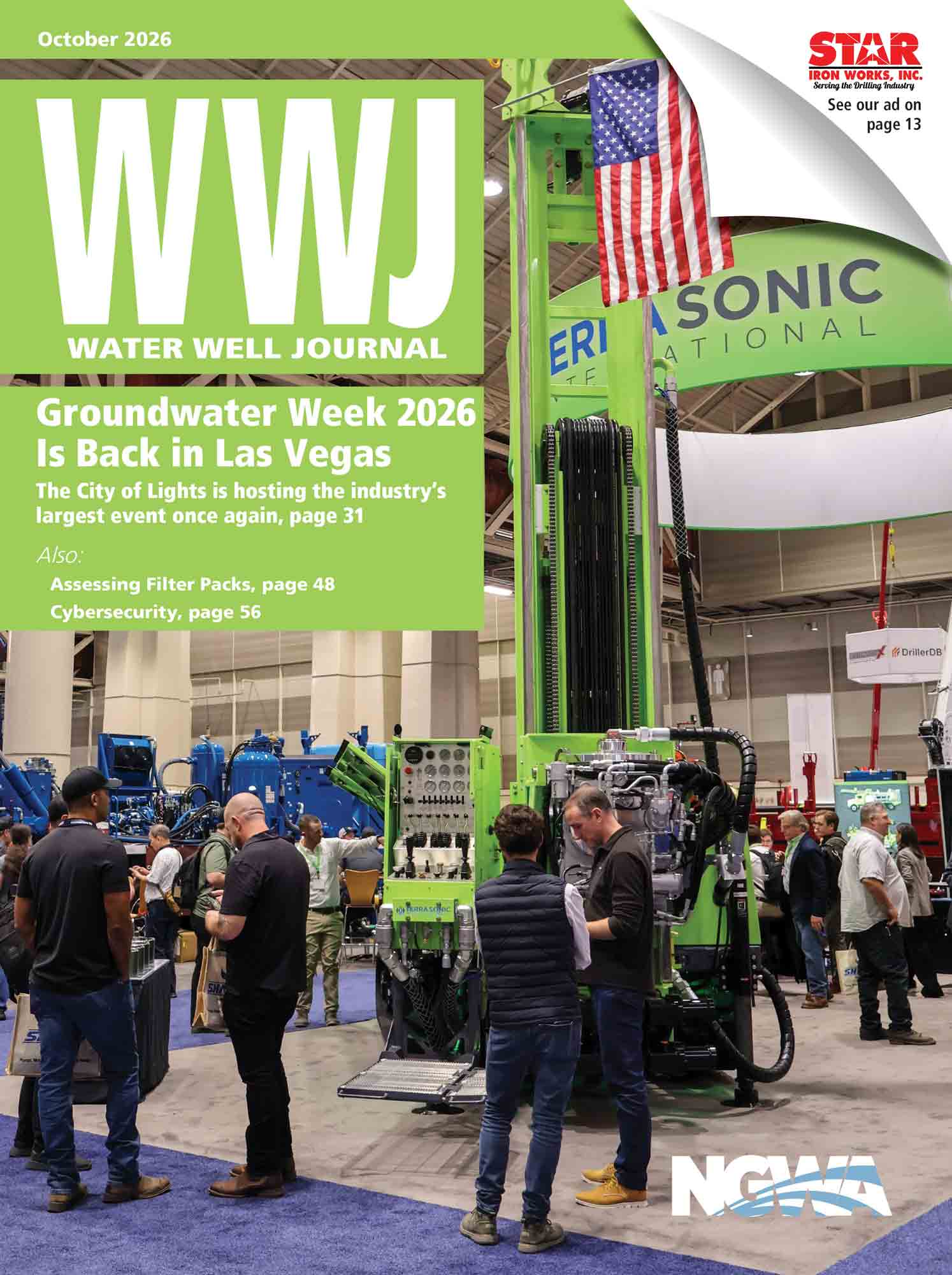
“For technology that was born five years ago, that’s pretty good,” says Henrich whose company is on this cover’s issue drilling a 10-well submerged closed-loop heat exchanger system for Darcy Solutions.
Current Market Dynamics
The transition to electrified heating and cooling systems has ushered in a new era where it’s now the starting base in commercial mechanical design.
Couple this design capability with today’s geothermal heat exchange technology, and the federal Investment Tax Credit under Section 48 fueling projects through 2034, and there appears to be a more hand-and-glove fit solution for today’s data center cooling demands. These elements weren’t here during the last geothermal growth period in the 2000s to early 2010s.
From the 30,000-foot view, the geothermal heat exchange technology and financial assistance through the federal Investment Tax Credit exist, with the only lacking piece being more designers, drillers, and installers to keep up with project demand.
“This isn’t a space you want to engage in five years from now,” Henrich states. “You’ll be hard pressed to make your investments, participate in the projects, and then recover your investment on what you put into it. The time to engage in these technologies is now.”
Henrich concentrated his efforts in 2025 on educating Minnesota policymakers and state regulatory agencies on how geothermal heat exchange technology is a logical answer to projects spanning data centers to thermal energy networks for municipalities to other applications.
Traut accompanied Henrich in some of these talks, and state regulators were appreciative of him explaining how geothermal technology, while not suitable for every setting, can achieve great results. Using the same gallon of water two times and not adding additional stress to water resources were given in these real-life scenarios:
- If a data center is near a power company, it could pump its already warm water to the power company for it to make steam, reducing its hot water heating cost.
- The same above example could conceivably work for municipalities to pump its water to cool a data center first, then the water in the geothermal system rises above normal groundwater temperature because of thermal buildup, and then the water being pumped to homes is entering 10℉ to 20℉ warmer than it would normally, reducing a customer’s hot water bill.
- An oil refinery already uses a lot of water, so pumping it through the data center heat exchanger first before its use can reduce aquifer use.
While Henrich is having dialogue about potential data center projects, his company’s horizontal closed-loop system in 2013 for Hormel Foods in Blooming Prairie, Minnesota, remains its only completed data center project to date. He and Traut are also in talks with large HVAC manufacturers about the market opportunity.
“It’s really kind of hard for me to conceive that our industry has been pushing a lot of these solutions from the bottom up,” Henrich shares. “It is very interesting that such a small community of unique professionals are talking about solutions for such a massively scaled problem.”
Future Market Dynamics
Traut points to U.S. energy economics and policy as the driving factor on the state of the geothermal market moving forward. If electricity is chosen over fossil fuels, the question becomes how to get the most out of a kilowatt.
The DOE states geothermal heat pumps can reach efficiencies of 300% to 500%, meaning for every unit of electricity they use, they produce three to five units of heating or cooling energy.
“There is no other better bang for the buck,” Traut says. “Yes, it has a higher upfront cost. That is true. So, if electricity gets expensive enough, and if fossil fuel gets expensive enough, then it’s going to look really good, and it’ll be a mainstay.”
In Europe, many companies pay about twice per kilowatt as companies in the U.S., so geothermal technology has an active life there because it’s a way to get more value of one kilowatt.
“We all find ways to save money,” Traut says.
In the coming years, Traut sees product innovation from Europe leading large HVAC manufacturers in the United States to invest in this marketspace. Improvement in current technology will make geothermal systems more affordable and efficient.
“It’ll be able to stand on its own when the tax credit does settle in 2035,” he says. “I’m trying to bring people into it and say, ‘Look, this works. Let’s open our eyes. If you guys want to make investments, then this is the thing that’s going to make sense.’”
 Mike Price is the senior editor of Water Well Journal. In addition to his WWJ responsibilities, Price contributes to the Association’s scientific publications. He can be reached at mprice@ngwa.org, or at (800) 551-7379, ext. 1541.
Read the Current Issue
you might also like

Study shows that both have their place and it depends on project objectives.

Steve Stone previews his microbial contamination workshop at Groundwater Week 2026.