
Technology and Profit

Part 2. Managing the company.
By Jason M. Flynt
Have you ever stopped to think about what we actually do, and how you might describe it to someone outside of our industry?
“We use heavy equipment, physical labor, diesel horsepower, and electricity to overcome gravity, logic, physics, and geology by putting lightning underground to produce the one thing that all life on earth can’t go without . . . from a rock.”
As a contractor, you are a plumber, electrician, mechanic, equipment operator, salesman, inventory manager, safety man, and employee counselor (at times)—and that is just the beginning. The list can go on and on and is as different as the formations and wells that we drill and set pumps in.
How does that all relate to technology and profit? Good question.
While some things in our business will not likely change anytime soon, other parts of what we do and how we do it may need to as technology and innovation change. ChatGPT says:
“Technology is the practical application of tools, machines, systems, and processes to solve problems, improve efficiency, and complete specific tasks.”
That is not much different from the comical description of what we actually do above.
If then technology is the improvement of something, then what might happen if we use it in our businesses to help manage parts of our company?
Real-World Example
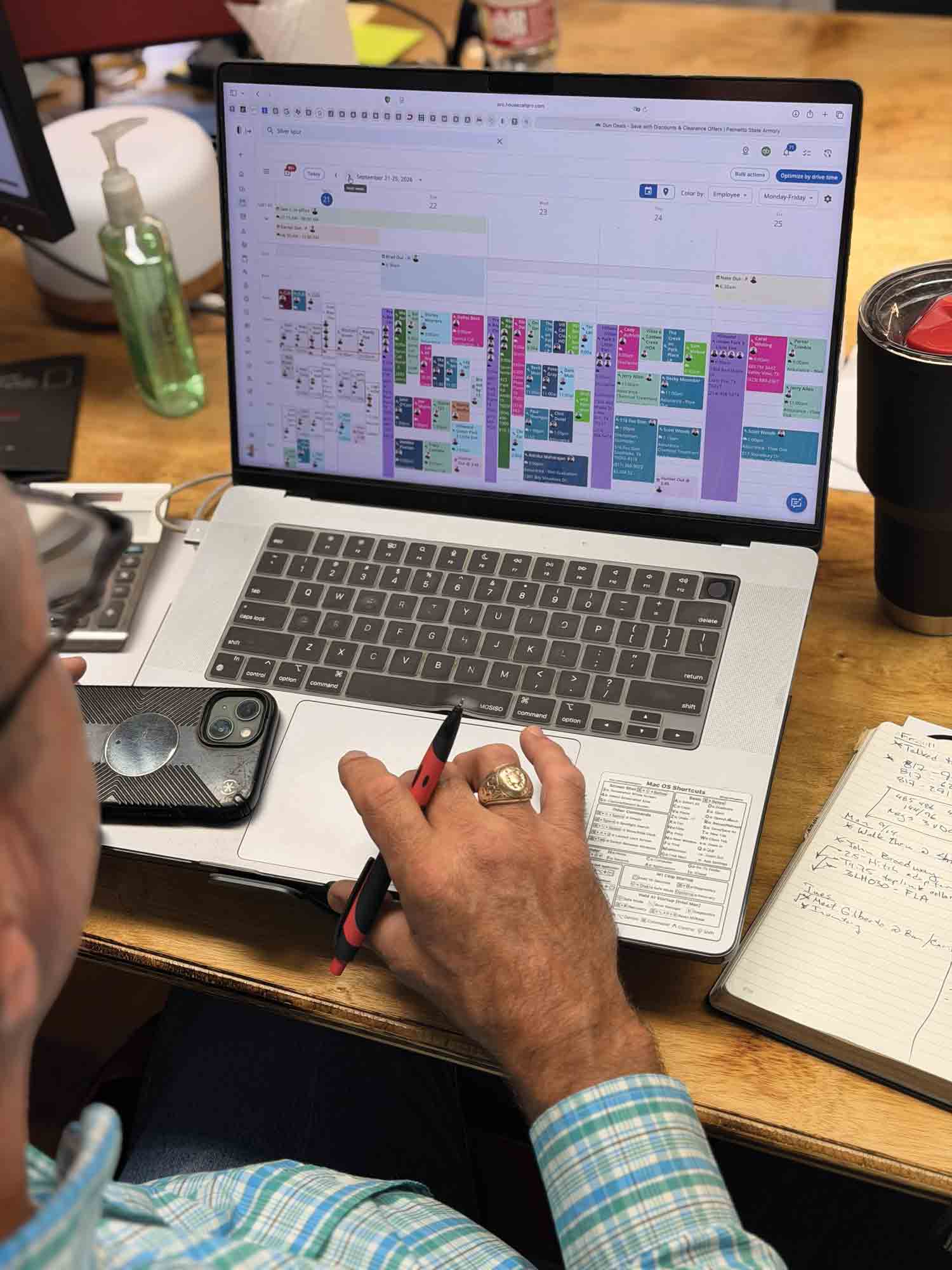
By using a solid CRM platform to first manage the customer, then manage the company and its assets—both human and mechanical—the author’s company has become more profitable. Photo courtesy author.
Like we did last time in Part 1 in the Water Well Journal My 2026 issue, join me for a second trip through a normal day and look at how technology can be employed to make things more efficient and ideally more profitable.
It’s 7 a.m. at the shop, and the first out-of-water call will be coming in shortly. As our technicians arrive, they clock in using our CRM (Customer Relationship Management) app. The app geolocates them when they clock in, so we know who is at the shop and available to be scheduled immediately.
The morning routine around our shop looks like the pick-up and drop-off line at an elementary school, and keeping up with who is available or scheduled is huge. We can schedule 22 guys and 11 trucks without going to look at timecards or leaving the office to see who is in the shop and playing the “What do you have on your schedule today?” game.
The phone rings at 7:15. It’s the first out-of-water call, and the information in the CRM app shows it is a 5 hp system on an 800-foot well. The location is one half mile from another service call on the schedule for 8 a.m. for another tech to replace a pressure tank for a “membership” customer.
The pressure tank call was scheduled by a tech yesterday as part of our “Assurance Program” where we proactively maintain and repair our customers’ well systems for a monthly fee. The tank has not failed; it just leaks down over a couple of months, so it can wait a couple of hours while we redirect the tech from the 8 a.m. call in a service body truck that does not have a pulling unit.
Now, for those of us who have priced trucks and pulling units lately, you know that it’s not hard to spend $70,000 on a service body truck, and a quarter million dollars on a medium-sized pulling unit. Both of those trucks have a finite number of miles or hours in their lifespan, but what it costs for each mile on a $70,000 truck and a $250,000 truck are very different. We have several of the service body trucks for jobs like the pressure tank or our 100-foot wells that we can pull by hand.
Back to the out-of-water call. We are going to have a tech in a 3/4-ton service truck close to the location that may not require a pulling unit and two-person crew. How many times have we all sent an F-550 with a 12,000-pound pulling unit on top and two-man crew 20 miles to a call to replace a pressure switch? The economics of that are terrible!
By using technology to improve scheduling and dispatching of company assets, we are able to recognize and recommit a much less expensive piece of equipment and a single technician to a job with a two-year-old pump, according to service notes on the app. The reassigned tech throws on a couple of extra parts to potentially make the repair from the previous service notes, and we are off to make a profit on a pressure switch or control box replacement, assuming that’s all it takes.
Same call, but let’s say the first tech diagnoses a pump and motor issue, and we do have to send a pulling unit crew. Which crew gets the job? Good question, and yet again we are using technology to help with the answer.
Like many of you, we have talented guys who excel and are more efficient at one part of our trade or another. When we began using the CRM app to schedule and dispatch, we linked the information from the time clock that also tracks every part of the job with the tech and crews. When a tech is en route to a job, the app tracks how long he is on that job until it is completed and billed. We also started inputting job material costs so we can tell almost immediately what our gross margin is on a job. The results were eye-opening.
What we thought our most profitable jobs were and what they actually are were not the same. Also, it became evident that we needed to change our pricing on some jobs to account for time spent on certain types of jobs with certain crews.
Lessons Learned with Help from Technology
Once we started looking at our most profitable jobs and which crews were completing them and where those jobs were, three interesting things happened:
1. We were able to see hard evidence of which jobs or segment of the market we need to focus on in marketing and advertising. Rather than deploying marketing dollars to chase what we thought was most profitable, we revamped some of our marketing to catch more of the type of job we made the most money on.
2. The second thing that happened when tracking every tech and crew hour: We saw how much time our guys are on the road. We have crews that spent 35% of their time in transit to and from jobs. Over one-third of the week was spent putting miles on trucks.
Remember the quarter-million-dollar pulling unit? A third of its week was spent with two guys in the seat
driving—not generating revenue. Back to the marketing dollars, we started spending marketing and advertising money in areas closer to our home base for the most profitable type of job and to minimize the amount of crew time spent sitting in traffic.
3. The last thing that happened when looking at tech and crew time profitability: We became keenly aware of who the most profitable techs and crews were. How many times have you had a conversation with an employee about compensation, and the decision to either give them a raise or not was based on “feeling” like they do a good job, or had a really good month?
We track tech and crew profitability and regularly address their bonuses or compensation accordingly. If
you have good talent and they are making you money, do what you must do to keep them. If you have some
who are less profitable, make decisions based on the real numbers when it comes time to review their pay.
Back for the last time to that out-of-water service call. We have access to our human assets as they are clocked in, and we can accurately dispatch those available. We sent a less expensive piece of equipment and a single tech who was close by to potentially handle a lower revenue call, but that didn’t work.
We then were able to send the appropriate truck and crew to the job based on efficiency and past performance on similar jobs. We were also able to price the work accurately based on the job and travel time associated with the area and location. The devil is in the details but so is the profit.
Our industry is no different than a lot of others in that those who recognize tools available that can make their life easier and more efficient generally will be more profitable. By using a solid CRM platform to first manage the customer, then manage the company and its assets—both human and mechanical—we have become more profitable.
Is this a one-size-fits-all type of tool? Absolutely not. Just as unique as each of our companies are, so will the solutions and technology be that can add profit and efficiency.
______________________________________________
We have looked at the advantages of using technology in the business. In the next column, we will look at the last part of the equation: the source. Look for that column in the May 2027 issue of WWJ where we will walk through the advantages of using technology to help manage water sources for both contractors and customers.
Learn these key takeaways like: What are potential options for exiting contractors? What can they do to prepare for an exit event? What can they do to improve the value of what they have built? Click here to learn more and register.
 Jason M. Flynt is a licensed driller/pump installer in the Dallas- Fort Worth area and managing partner at Barco Well Service LP. He also founded Resource Monitor Inc., a technology company to remotely monitor water wells and water sources. He can be reached at jason@resourcemonitor.com.
Read the Current Issue

you might also like
Click here to learn more about this workshop, Digitization of [...]


Five communication habits that make customers want to say yes.


