Assessing Glass-Bead and Natural-Gravel Filter Packs

Study shows that both have their place and it depends on project objectives.
By Thom Hanna, PG; W. Richard Laton, Ph.D., PG, CHG, CPG, NGWAF; and Jinka Kawasaki, GIT
I was asked how do you size glass beads: Do you do it the same as gravel filter packs or different?
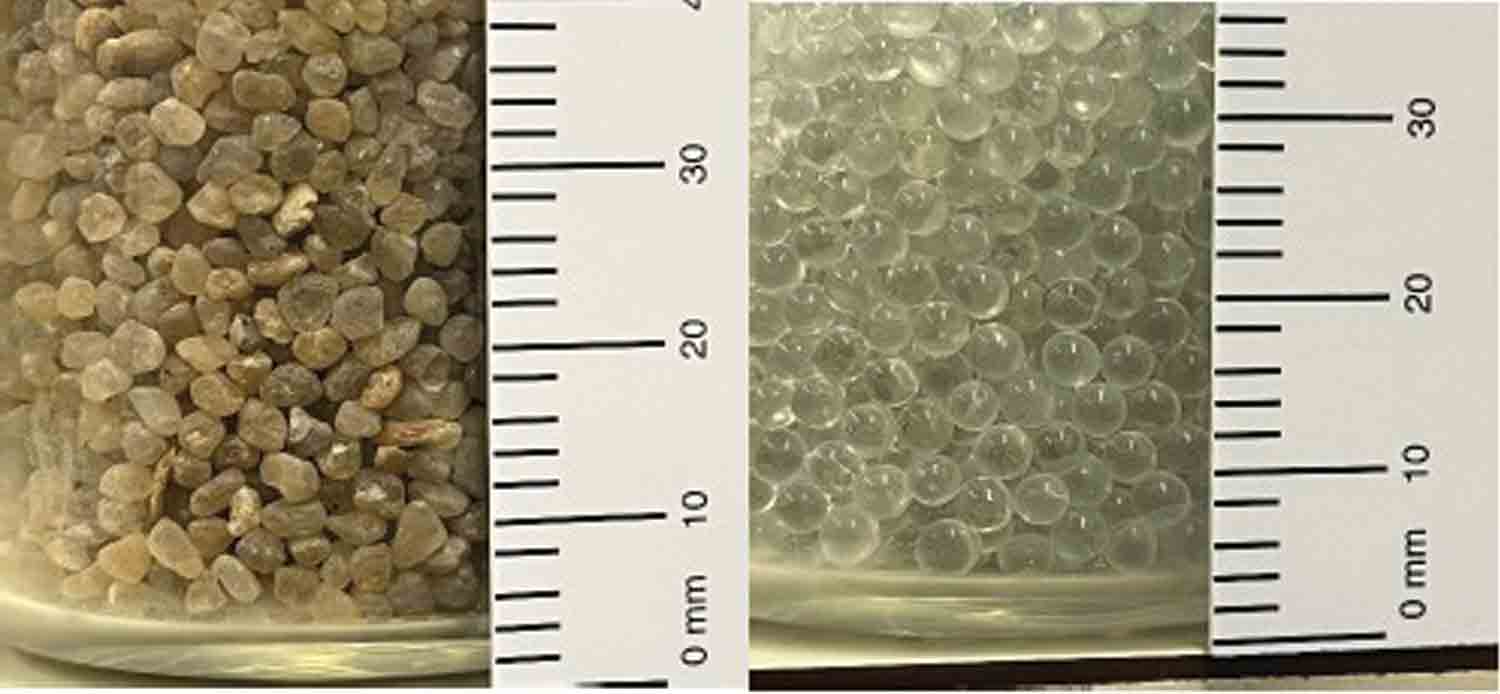
Figure 1. Sand 6-9 (left) and Shur Pak 5-7 (right) showing angular and spherical packing behavior (Kawasaki 2025).
I had some ideas based on what I had seen in the field, but wanted to get better answers, so I asked students at California State University, Fullerton to do some testing to help determine how best to size a filter pack for a glass-bead filter pack.
This column is a brief summary of the sizing experiments and evaluates the theoretical pore-throat size and expected filtration capacity of 3-inch filter beds containing engineered glass beads or natural gravel.
The glass beads have approximate roundness and sphericity values of 0.9, while the gravel has values of 0.7. A geometric equation representing the opening between three equal touching spheres was used for the glass beads. An adjustment was used for compacted, well-mixed gravel encountered during well development.
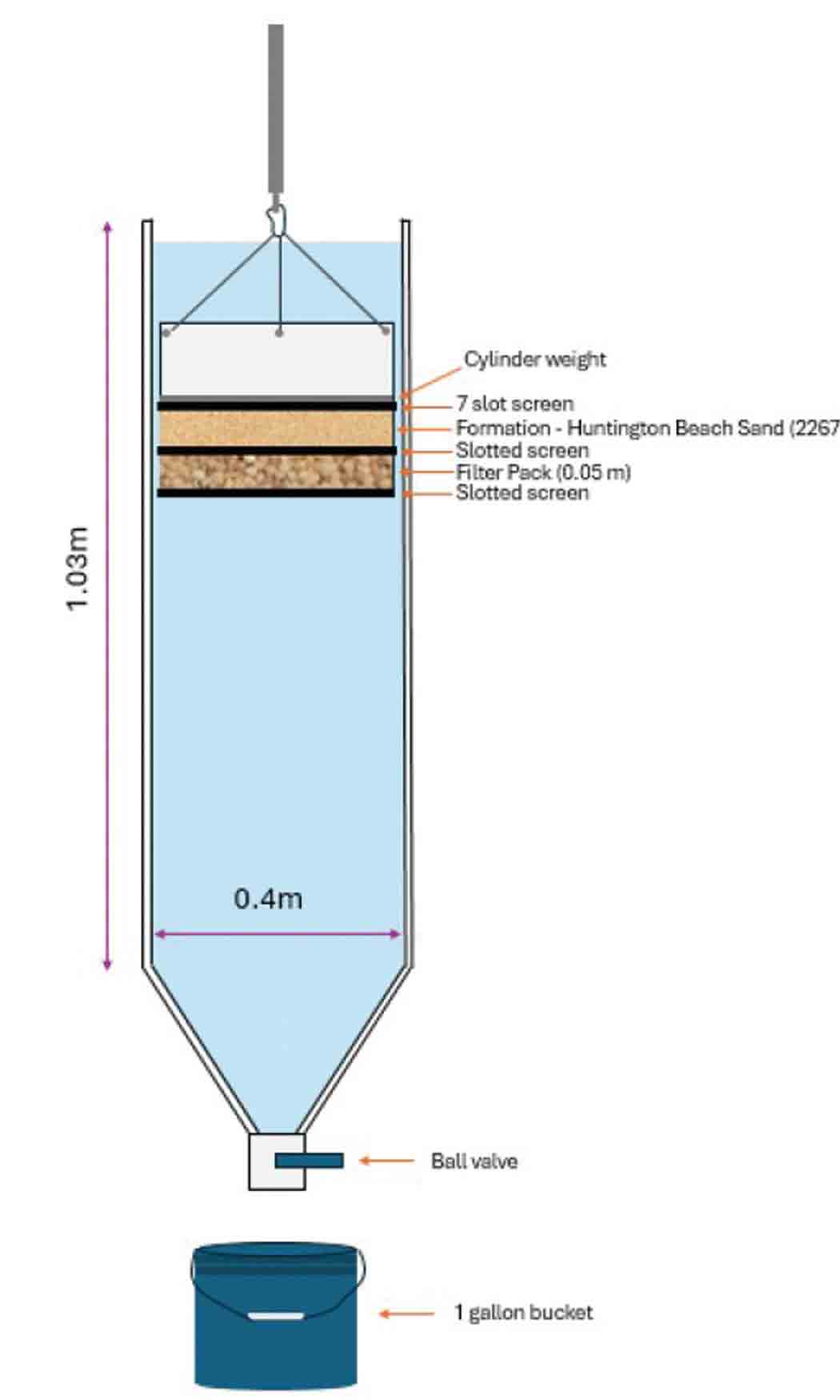
Figure 2. Schematic of the Well Dev Simulator in-lab apparatus used to observe filtration behavior through filter packs and formation material. The bucket would lift and drop based on the programmed code.
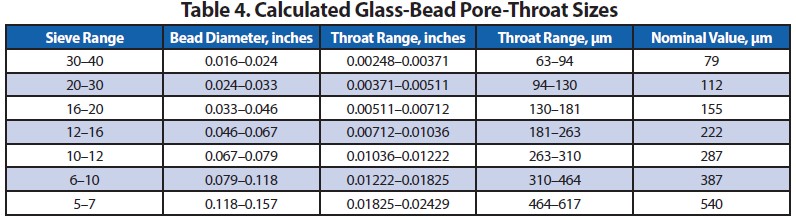
The calculations predict nominal pore-throat sizes of approximately 79–540 μm for the evaluated glass-bead grades and 87–669 μm for the compacted gravel grades. However, laboratory tests indicate that more fine sand passes through comparable glass-bead packs than through gravel packs. This apparent disagreement occurs because a single idealized opening does not represent a complete three-dimensional pore network. Particle-size distribution, compaction, connectivity, tortuosity, surface roughness, bridging, and hydraulic loading can make a broadly graded gravel pack retain finer particles than predicted by simple geometric equations.
The calculated values should therefore be treated as comparative geometric estimates rather than absolute filtration ratings. Laboratory retention results should control final filter pack selection.
Laboratory Study
The hydraulic and filtration performance of any filter pack is governed by how the grains pack, which can be influenced by grain shape, distribution, and size. The filter packing controls porosity, pore-size distribution, and pathways for fine-particle retention and movement. That network for retention and movement is the pore-throat size distribution.
In a random close packing of granular particles, Patmonoaji (2020) found that angular particles generate smaller pores, but larger throats than spherical particles. In addition, they found that as the particles become more angular, the pores get more irregular. Angular grains create interlocking structures with narrower pores, while spherical beads create predictable, uniform pore networks (Figure 1). In addition, natural sands vary in shape, which leads to variable packing, while glass beads are spherical, which leads to predictable packing.
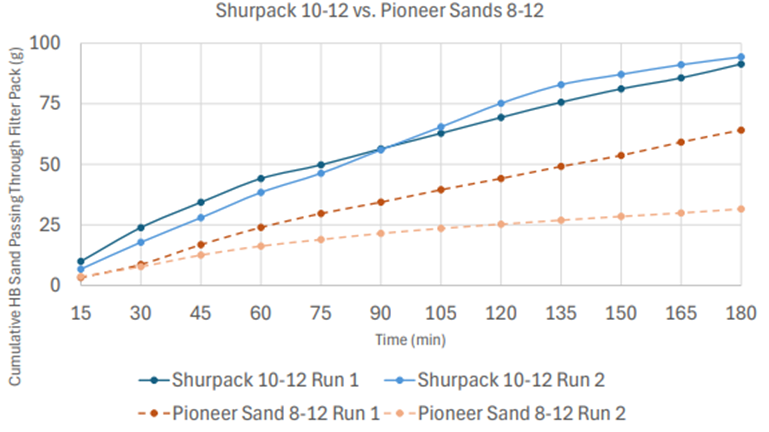
Figure 3. Comparison of Shurpack 10-12 and Pioneer Sands filter pack performance in the filtration of sands. The Shurpack continues to allow sand to pass, while the gravel pack retains more sand and comes close to preventing sand through after three hours of development.
An in-lab study found that spherical glass beads and rounded/medium sphericity grains were prone to the migration of fines compared to angular/low sphericity grains (Maroof et al. 2021). In addition, the study found that a reduction in sphericity or roundness decreased the rate of fine-grain erosion. The same paper also found that as roughness increases, the constriction size and coefficient of permeability increase, but the trapping of fine grains in the constriction increases.
Kawasaki (2025) conducted laboratory studies to compare the sizing of glass-bead filter pack to natural filter packs. Sand from Huntington Beach, California, was collected, sieved, and used as the formation for this project. It is a uniform medium sand with a uniformity coefficient of 1.6, ranging in size from 149 μm to 4760 μm.
This sand was selected as the formation because artificial filter packs are generally useful in aquifers composed of highly uniform unconsolidated sediments. A total of 12 filter packs, comprising six sand and six glass-bead filter packs of varying sizes, were used (Table 1).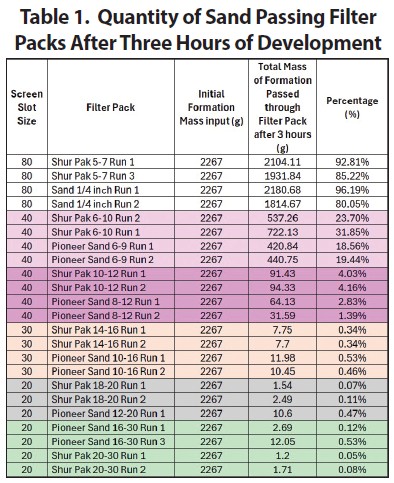
Glass-bead filter packs with size distributions matching those of sand filter packs were compared to assess performance differences. All filter packs had uniformity coefficients ranging from 1.1 to 1.8. The glass-bead filter pack is Shur Pak from Johnson Screens, while the sand filter packs are Pioneer Sands.
Using the WellDev Simulator (Figure 2), an in-lab apparatus, we measured the mass of a standardized, uniform sand formation after it passed through various glass-bead and sand filter packs. It utilizes a bucket layered with a screen at the bottom, a 2-inch filter pack, a screen, 2267 gallons of formation, 7-slot screen, and cylinder weights at the top.
Four hollow 2-inch metal cylinders were placed in the filter pack to prevent the middle screen from tilting and to keep the filter pack in place as water surged through. The proper slotted screen at the bottom of the bucket was selected to ensure none of the filter pack passed through.
The 7-slot screen on top is designed to prevent any formation from escaping through the bucket’s top during surging. The bucket is hooked onto a metal rod that is attached to a compressed-air system and coded so that it is repeatedly raised and lowered through a vertical tank of water. It takes 3.5 seconds to move up 0.381 meters and five seconds to move down. The velocity going up is 0.109 m/s, and down is
0.076 m/s. This movement allows the water to move through the bucket.
Figure 3 shows that the threshold has been reached where the glass-bead filter pack continues to allow the Huntington Beach sand through 10-12 Shurpack glass beads while the equivalent 8-12 gravel filter pack is holding the formation in place after three hours of development. Larger sizes allowed the Huntington Beach sand to pass through, while smaller sizes retained the formation sands.
Mathematical Evaluation of Filtration
Filter Pack Characteristics
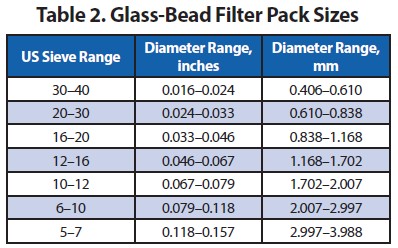
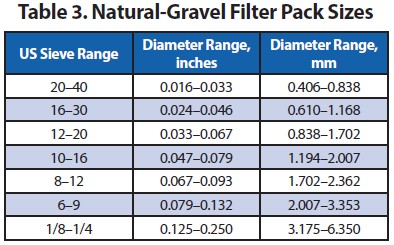
The comparison considers 3-inch-deep filter packs containing either glass beads or natural gravel. The glass beads are highly rounded and nearly spherical, while the gravel is less rounded, less spherical, and more broadly graded (Table 2 and Table 3). The gravel packs are assumed to undergo compaction during development, while glass beads due to their uniform and spherical nature do not compact. The gravel packs are assumed to be well mixed and mechanically compacted during development.
Bed depth increases the number of constrictions encountered by a migrating particle, but it does not directly change the dimensions of one local opening. A deeper bed may increase interception, pathway tortuosity, and bridging, but depth should not be used as a direct multiplier in a geometric pore-size equation. A 3-inch filter pack was assumed for the calculations.
Glass-Bead Pore-Throat Calculation
For three equal spheres in mutual contact, a two-dimensional plane through the centers produces a triangular opening. The diameter of the largest circular particle that fits through this opening is:
dt = (2/√3−1) D
which simplifies to:
dt = 0.1547D
where:
- D is the glass-bead diameter
- dt is the theoretical pore-throat diameter.
The equation is a reasonable geometric reference for highly rounded, narrowly graded glass beads. It is not a complete filtration equation because it assumes identical spheres, ideal contact, a two-dimensional opening, and purely mechanical straining.
The pore-throat range was calculated as the difference between the minimum and maximum bead diameters for each grade. Inches were converted to micrometers using:
1 inch = 25,400 μm
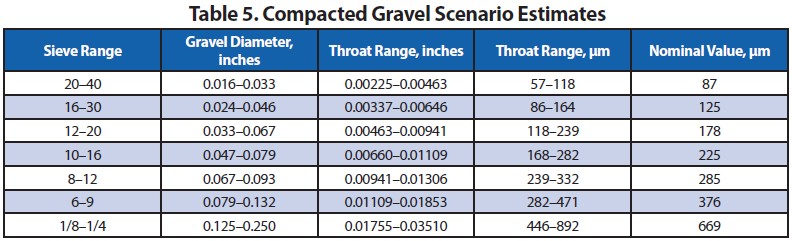
The midpoint of each calculated range is reported as a nominal comparison value (Table 4). The upper end represents the larger geometric opening associated with the coarse end of the grade.
These values represent ideal openings. They are not absolute micron ratings. A real particle must travel through a connected sequence of three-dimensional pores and constrictions, not through one isolated triangular opening.
Compacted Gravel Calculation
The gravel calculation is more uncertain because natural gravel has a broader particle-size distribution and irregular grain geometry. The earlier comparison used a porosity adjustment to represent the effect of compaction.
The characteristic pore-dimension correction was calculated as:
Fc = nc /(1-nc)
_____
nl /(1-nl))
where:
- nl = 0.40, assumed loose-bed porosity
- nc = 0.32, assumed compacted-bed porosity.
Therefore:
Fc= 0.32/0.68
_______
0.40/0.60 = 0.7059
Applying this factor to the previous shape-adjusted gravel
relationship produced:
dt,gravel = 0.1404D
This equation reproduces the comparative gravel table seen in Table 5, but it should be treated as a scenario estimate. There is no validated universal relationship between gravel diameter and pore-throat size. Roundness and sphericity do not alter pore dimensions through a simple linear multiplier. Grain shape affects packing orientation, contact arrangement, tortuosity, and pore connectivity in more complicated ways.
Research on granular filters shows that idealized inscribed-circle calculations can poorly predict the constriction-size distribution of widely graded materials because the calculations oversimplify the actual granular fabric (Shire and O’Sullivan 2016).
Comparison with Laboratory Findings
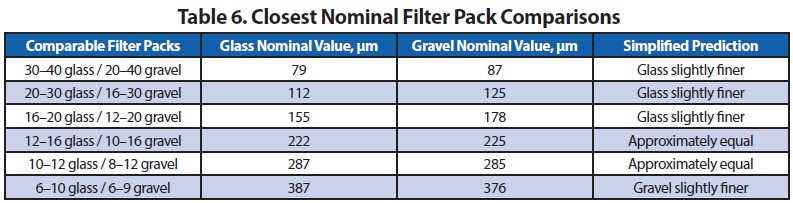
For several comparable grades, the simplified calculation predicts that glass beads should filter particles equal to or smaller than those filtered by gravel. Laboratory studies instead show more fine sand passing through the glass-bead packs.
This difference indicates a limitation in the equations rather than an error in the laboratory results. See Table 6.
Reasons for the Difference
An opening is not a complete pathway.
The three-sphere equation computes a single local opening. Actual particle passage depends on whether a continuous sequence of openings extends through the 3-inch filter pack. A particle may pass through a bed containing many small constrictions if one connected pathway remains sufficiently open. Conversely, a gravel pack may contain large pore chambers but retain fine sand because the passages connecting those
chambers are narrow or poorly aligned.
The relevant property is therefore the constriction-size distribution, including the connectivity of the constrictions, rather than a single calculated pore diameter. Constrictions are the narrowest sections that connect larger pore volumes and are the principal geometric obstacles encountered by migrating particles (Vincens et al. 2014).
Glass beads can produce continuous channels.
The glass beads are smooth, highly rounded, and relatively uniform. These characteristics can produce regular and well-connected pore channels.
The regularity provides hydraulic benefits, including comparatively high conductivity and low flow resistance. However, regular channels can also allow fine particles to move through the clean bed. A particle contacting a smooth bead may roll or slide around the bead and continue through the pore network.
Engineered glass-bead filter packs are associated with consistent porosity and favorable hydraulic performance. Those properties can improve well efficiency and facilitate the removal of deposited material during development or backwashing, but they do not necessarily provide the greatest initial retention of fine sand (Gin 2025).
Broad gravel gradation fills voids.
The gravel products contain a broader distribution of particle sizes. When well mixed, the smaller gravel grains can occupy spaces formed between the larger grains.
Large particles establish the structural skeleton, intermediate particles fill portions of the large voids, and smaller particles reduce the remaining openings. Compaction can enhance this process by rearranging the material and moving smaller grains into available spaces.
This hierarchical void-filling is not represented by applying one coefficient to either endpoint of the gravel-size range. Polydisperse granular beds can exhibit substantially different pore-throat distributions and particle-trapping behavior compared with beds containing uniform spheres (Vyas et al. 2024).
Irregular gravel produces tortuous paths.
Angular or subrounded gravel may create large individual pore bodies, but the connections between those pore bodies can be small, misaligned, and tortuous.
Irregular gravel can create:
- Abrupt changes in flow direction
- Narrow grain-contact throats
- Dead-end pores
- Mechanically stable pockets
- Misaligned openings
- Direction-dependent passageways.
Total porosity, therefore, does not necessarily indicate the size of connected pathways. Particle shape affects pore morphology, constriction dimensions, topology, and blockage behavior in ways that cannot be represented by a simple shape ratio (Abdallah et al. 2024).
Roughness and bridging increase gravel retention.
The calculations principally represent geometric straining. Laboratory filtration also includes interception, settling, mechanical lodging, surface attachment, and bridging.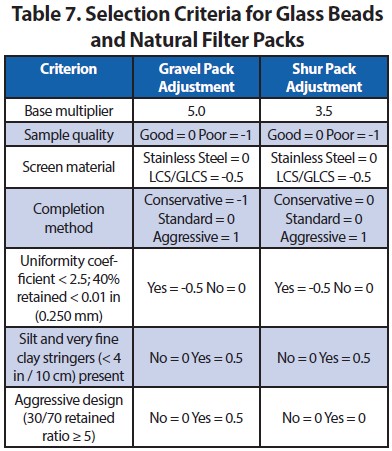
Rough gravel surfaces have depressions, projections, and irregular contacts that can trap fine sand. Once several particles become lodged, they create secondary constrictions. Additional particles then bridge against the deposited material, causing effective openings to become progressively smaller.
This filter-ripening process may develop faster in gravel than in smooth glass beads. Particles deposited on smooth beads may be more easily mobilized, while particles lodged at angular gravel contacts can form stable bridges.
Conclusions
The ideal three-sphere equation provides a useful geometric reference for narrowly graded glass beads, but it does not provide an absolute filtration rating. The calculated glass-bead values range from approximately 79 to 540 μm on a nominal basis. These values are suitable for comparing glass-bead grades under consistent geometric assumptions.
The compacted gravel values range from approximately 87 to 669 μm, but these results depend on assumed porosity and an empirical shape adjustment. The gravel equation should be treated as a scenario calculation rather than a general physical law.
The laboratory finding that more fine sand passes through glass beads than through comparable gravel is physically credible. Smooth, narrowly graded beads can form regular and connected pathways. Broadly graded gravel can develop smaller effective constrictions through void filling, compaction, tortuous flow, surface interception, and bridging. Kawasaki (2025) concluded that an initial multiplier on the 70% retained should be used for glass beads as is less than that for natural gravel packs based on controlled laboratory conditions.
Field experience (Hanna 2025) and other factors, such as sample reliability, aquifer layering, and the uniformity coefficient of the aquifer sample, lead to a starting base multiplier of 1 to 1.5 lower for glass beads than for a gravel pack. Other variations for sample quality, completion, uniformity coefficient, silt and clay stringers, and aggressive design for formation with a high percentage course materials (Table 7) have been used to create a system to size filter pack with glass beads or gravel.
Glass beads may provide greater hydraulic efficiency, predictable packing, easier development, and improved backwashing. Compacted gravel may provide greater initial retention of fine sand. The preferred medium, therefore, depends on whether the primary objective is sand control, hydraulic efficiency, resistance to clogging, ease of development, or long-term operation.
References
Abdallah, A., Vincens, E., Magoariec, H., Ardabilian, M., and Picault, C. 2024. Effect of particle shape on the void space in granular materials: Implications for the properties of granular filters. Granular Matter 26, Article 97. https://doi.org/10.1007/s10035-024-01452-0.
Gin, G.M. 2025. An introduction to engineered glass beads as a filter pack media. Water Well Journal 79, 8: 19-25.
Hanna, T.M. 2025. Filter pack differences. Water Well Journal 79, 10: 54-57.
Kawasaki, J. 2025. Sizing of glass-bead filter packs in water wells. California State University, Fullerton. Master’s thesis.
Maroof, M.A., Mahboubi, A., and Noorzad, A. 2021. Effects of grain morphology on suffusion susceptibility of cohesionless soils. Granular Matter 23, 1, Article 8. https://doi.org/10.1007/s10035-020-01075-1.
Patmonoaji, A., Tsuji, K., and Suekane, T. 2020. Pore-throat characterization of unconsolidated porous media using watershed- segmentation algorithm. Powder Technology 362: 635-644. https://doi.org/10.1016/j.powtec.2019.12.026.
Shire, T., and O’Sullivan, C. 2016. Constriction size distributions of granular filters: A numerical study. Géotechnique 66, 10: 826-839.
Shire, T., O’Sullivan, C., Taylor, H., and Sim, W.W. 2016. Measurement of constriction size distributions using three grain-scale methods. In Proceedings of the 8th International Conference on Scour and Erosion (ICSE 2016), Oxford, UK, September 12-15, 2016.
Vincens, E., Witt, K.J., and Homberg, U. 2015. Approaches to determine the constriction size distribution for understanding filtration phenomena in granular materials. Acta Geotechnica 10, 3: 291-303. https://doi.org/10.1007/s11440-014-0308-1.
Vyas, D.R., Gao, S., Umbanhowar, P., Ottino, J.M., and Lueptow, R.M. 2024. Impacts of packed bed polydispersity and deformation on fine particle transport. AIChE Journal 70, 9: e18499. https://doi.org/10.1002/aic.18499.
 industry.
It features 20 years of advancements in technology and knowledge gained in the field. Included are new borehole geophysical techniques, information on underbalanced and horizontal drilling, new approaches to well development, as well as details on ASR, groundwater monitoring and remediation, prepack screens for water interactive well design and well maintenance programs for water well contractors and design engineers.
Click here to order it, call (800) 551-7379, fax (614) 898-7786, or email customerservice@ngwa.org.
 Thomas M. Hanna, PG, is a technical director of water well products/hydrogeologist for Johnson Screens where he works in areas of well design, development, and well rehabilitation. He is a registered professional geologist in Arizona, Kentucky, and Wyoming and has worked for several groundwater consulting firms. Hanna can be reached at thom.hanna@johnsonscreens.com.
W. Richard Laton, Ph.D., PG, CHG, CPG, NGWAF, is an expert in geology, hydrology, and hydrogeology. He is currently a professor of hydrogeology in the Department of Geological Sciences at California State University, Fullerton, and the recipient of NGWA’s 2014 Ross Oliver Award.
Jinka Kawasaki, GIT, is a recent graduate from California State University, Fullerton, where her thesis project was on “Sizing of Glass Bead Filter Packs in Water Wells”. She currently works as a staff geologist at Genesis Engineering and Redevelopment, an environmental consulting firm.
Read the Current Issue

you might also like

INTRIC Grouting Solutions Inc.'s systems are built around field experience and reliable performance.

Design, architecture, and troubleshooting guide.