Water Well Journal Q&A

MIKE HEATWOLE, MWS
The A. O. Smith regional sales manager in the Mid-Atlantic identifies common issues and best practices for solving problem water.
By Mike Price
An interesting talk on discovering signs of water problems from looking at the back of a toilet tank was held at Groundwater Week 2024.

Mike Heatwole, MWS
Mike Heatwole, MWS, presented clues to look for to decipher what’s happening with the water supply and in making the proper water treatment recommendation in the appropriately named workshop, “Toilet
Talk—Lessons from Looking in the Back of the Toilet.”
As well and municipal water treatment can be tricky, the A. O. Smith regional sales manager in the Mid-Atlantic region says the simple step of checking the back of the toilet tank is a must. Along with it, Heatwole’s workshop tackled helpful hints and ways of identifying problem water, identifying if the problem is water treatment or premise plumbing, and how to use clues that aren’t on a water analysis sheet.
Collecting as much information from the customer is needed too.
“Get the customer involved as much as you can,” says Heatwole, an industry veteran who has served on the Board of Directors for the Virginia Water Well Association for the past 25 years.
With April’s issue focusing on water quality and water treatment, Water Well Journal asked Heatwole about his Groundwater Week 2024 workshop and other related questions.
Water Well Journal: As the title of your Groundwater Week 2024 workshop implies, why should contractors check the toilet tank to decipher the cause of problem water?
Mike Heatwole, MWS: As a water treatment professional, we are called upon for our expertise in solving a customer’s water issue. The customer looks to us for answers and solutions and they expect correct suggestions. This is a great responsibility and not one to be taken lightly. We must use all the tools available to us to determine the root cause of the problem and by doing so make a correct diagnosis.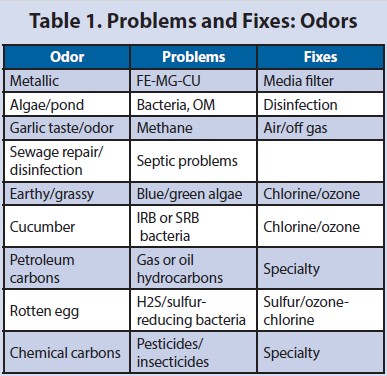
Proper water testing as well as measuring water flow available from the water source for the equipment to function properly are key to understanding what we need to offer our customers for a solution. We have a saying at A. O. Smith North American Water Treatment that goes: “When you have a proper water test, the test will tell us how to treat the water.” I will not make a recommendation without proper water analysis.
Many water treaters rely on “mail off” testing instead of using good field test analysis. They believe these are better, and they may be, and they don’t want to assume the responsibility of making an incorrect diagnosis. While many labs do a great job, there is the wait factor for an answer but also many water parameters will change due to temperature fluctuations, off gassing, and oxidation that occur over time. I recommend using both field analysis and lab analysis to help make a proper problem water diagnosis.
There are two other key factors that help make a proper recommendation. I like to get a good description of the problem directly from the homeowner as well as checking in the back of the toilet. The back of the toilet is an accumulation over time of what is in the customer’s water. There are some telltale signs of water issues that will show up there that provide valuable and pertinent information. This opportunity is often overlooked. It just takes a little time and effort on the part of the technician. After all, this is the water the customer is using.
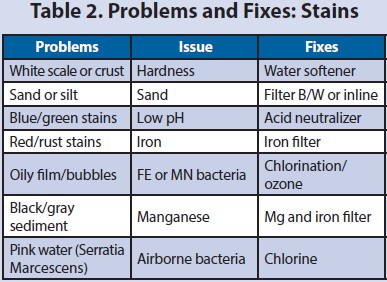
Tables courtesy A. O. Smith North America Water Treatment in Appleton, Wisconsin.
WWJ: Your workshop also provided instruction on how to use clues not found on a water analysis sheet in identifying problem water. What are the most important clues a contractor should look for?
Heatwole: Some often missed key information and clues that are missed by contractors include:
Not having a good conversation with the person who lives or works at the jobsite to get from them in their words what they believe the problem or complaint is. I have found over the years that the homeowner can offer valuable insight as to what the key or underlying issue may be. Ask and they may just give you the information you need. Asking questions is the best way to build trust between you and the customer.
Look around. Is there visible staining? How about smells or odors? How does the plumbing and piping look? Is the pump and pressure tank working properly? One of my abilities to work successfully on problem jobs is my knowledge of pumps, well tanks, and geology. Sometimes the water treatment issue is not a water quality problem. When you touch someone’s system, you tend to own the issues. Be versed in all aspects of the water system if you can, and of course, look in the back of the toilet.
WWJ: Emerging contaminants like PFAS is a huge concern today. What are the first steps that should be taken if PFAS needs treated?
Heatwole: Such an interesting topic. Obviously, the first thing is to have your water tested to determine if PFOS and PFOA are of concern. Depending on which study you read, somewhere between 40 to 60 percent of the U.S. population has some chemicals in their water, both municipal and well water. Exposure is of concern. Many municipal supplies have already been tested, and you can go to your local water body to find the information. Look for the CCR or consumer confidence report. Systems are required to report their findings and make them public at least once per year.
If not, there are several good websites that will help determine if you are at risk. The Environmental Working Group has a good website that hosts the Tap Water Database. Another good site is the WQRF. This is the research arm of the Water Quality Association and hosts the Containment Occurrence Map.
Private well testing is expensive, running from $89 to several thousand dollars. How the test is taken is critical as almost everything has some PFOA that can ruin the sample, so be careful and follow instructions closely.
Next, determine if the need is for a private well/homeowner or a commercial certified system. This requires a professional engineer to become involved and the rules change a bit. Pilot studies may need to be set up and run. Carbon and resin studies may need to be performed. Certainly, the sizes of the systems become larger.
Evaluate which technology you are going to use. This is changing daily as new technologies are being developed and more systems are becoming certified. Be sure to use independently certified technology as there are many false claims being made today. If it sounds too good to be true, then maybe it is!
Treatment today is becoming easier as we are constantly learning what and how to apply these new treatments. Stay up to date with the National Ground Water Association [NGWA.org/PFAS] and WQA amongst other reliable websites.
- Problems develop after treatment equipment is installed
- Customers blame water treatment equipment
- Check for proper plumbing: dead ends, galvanized nipples
- Ask about changes in soaps, detergents, etc.
- Dyes react with H2O
- Have water usage patterns changed?
- Pods can cause different reactions.
- Install test ports after each piece of treatment equipment.
- Provide an annual service on equipment and monitor water.
- Chlorinate plumbing lines after all equipment installations.
- Add filter housing after all equipment to chlorine service lines.
- Always keep all water test results every time the water is tested.
- Use certified and quality plumbing products.
- Use good plumbing techniques.
- Maintain open communication with customers.
- Be honest. Don’t BS!
Information courtesy A. O. Smith North America Water Treatment in Appleton, Wisconsin.
WWJ: What are your thoughts on microplastics as an emerging contaminant?
Heatwole: Microplastics have lately been the question most asked by consumers to my dealer/contractors lately, surpassing PFOS/PFAS. I feel with all the plastic in our daily lives, it is more real to the average person than something we cannot see like PFOS/PFAS.
Like many new emerging contaminants, we have a lot to learn. What size is a microplastic? How does it, or can it, affect human health? Are some good and some bad? So many questions and so many concerns. Time and science will tell, but the good news is this: We currently have water treatment technologies to remove microplastics from our drinking water.
WWJ: If contractors are leery of offering water treatment, what would you say to them?
Heatwole: Good for you. As much as I personally believe that offering water treatment is the best way to serve a customer, I recognize that we are not all water treatment people. A good businessperson recognizes what they are good at, and they stay in their lane. It’s a real commitment to do water well and we can’t all do that and that’s just fine.
“The industry must become active at the local, state, and national levels to ensure new laws make sense to protect our groundwater and water quality.”
This does not mean that you could not hook up with a good water treatment provider. I know many successful relationships where a driller passes on leads to a water treatment company and a good water treatment company offers info to the pump installer or water well provider. Find someone you trust and help each other to grow your respective business. There are plenty of opportunities for all of us.
WWJ: What should be the first steps a contractor takes in offering water treatment?
Heatwole: The first step is to determine if the contractor is willing and able to commit to the water treatment side of the business. While adding water treatment to the existing business sounds fairly easy at first, and it certainly can be, it’s important to recognize that it cannot become second fiddle to the rest of the business.
I’ve seen too many cases where a down pump, service call, out of water call, whatever, delayed the water treatment install to the point that the consumer cancelled the order. This makes the water treatment customers realize that they are not a priority. The business must be able to run and operate together without one side taking a back seat to the other. Many contractors are not willing or able to invest in talent and resources to operate both sides of the business simultaneously.
Once a commitment is made or can be made, put the plan in place. It’s important to connect with a reputable supplier who supports a great manufacturer of water treatment equipment. You want to be able to trust that you are receiving complete support from both parties to ensure that you are being
serviced at the highest levels. Product, training resources, warranty, and personal field support are necessary and welcomed by all and needed in most cases to ensure success. Water treatment is not rocket science, but the lack of support all the way through the process is where I see failure occur.
Walk before you run and build upon your success. Many people want to be able to tackle the jobs I see, but they have to develop expertise, and this takes a little time. There are so many simple opportunities to help customers improve and enjoy their water and that can help the contractor grow and develop as a water treatment professional.
Lastly, commit to learning. Learn how to do water. Get involved with NGWA as they have many great training resources. WQA is another great organization to gain knowledge from. Subscribe to trade magazines and read them. Use online training resources offered by your equipment manufacturer. Knowledge cannot be learned by osmosis.
WWJ: What should a contractor know when purchasing a test kit?
Heatwole: Invest in a good test kit. Learn how to use it. Then use it on every job. Even if the customer does not buy equipment, test the water. Keep records and record the results. Over time, using the kit and making observations, you will become a water expert. I learned a lot of what I know from an applications standpoint because I conducted the test, recorded the results, and made observations.
There are many good kits on the market. Find one that is from a reputable company, is easy to get replacement reagents for, and meets your water quality needs. Check the parameters you are testing for. If you are in a high iron area, don’t get a kit that only goes to 2 mg/l or ppm. Strips are easy but good for general work [think hand grenades]. Drop titration tests are much better and reliable. The new digital devices are quick, have a link to a computer, and are sexy to use but don’t always give you the same results. Most people don’t know how to keep them calibrated or even that they should. Check the dates on the reagents and protect them from freezing and overheating.
Your kit is like an expensive tool because it is. Most importantly, learn how to use it, then do so. The most important thing is to invest in a good kit, learn how to use it, keep it up to date, and it will serve you long and well. It will become your least cost investment and most profitable part of your company.
- Make sure your equipment is working.
- Shock and chlorinate well; interior plumbing lines.
- Shock and flush hot water tank.
- Check the anode rod.
- Check supply lines and stop valves.
- Check drain and waste lines.
- Check water flow inside the home and equipment sizing.
- Question everything.
Information courtesy A. O. Smith North America Water Treatment in Appleton, Wisconsin.
WWJ: Lastly, what are the top issues facing the water treatment industry?
Heatwole: There are many issues facing the industry today and I will mention but a few. Many are shared by all of us who work in the trades.
Labor: Finding and keeping qualified candidates for all our needed positions. We are doing a fair job at attracting young people into the industry, but we must find ways to attract more. I’m glad to see more females entering the industry. They bring a fresh perspective and new talents.
Government regulations: This is a double-edged sword in my opinion. The industry must become active at the local, state, and national levels to ensure new laws make sense to protect our groundwater and water quality. We must learn to work with our rule makers and not against them. We are a valuable resource. I was in Richmond, Virginia, working on a bill recently and was wearing my WQA MWS pin. A lady on the elevator saw it and said, “Oh, we need you!” Get involved as you can make a difference.
Rule changes: As I answer these questions, it seems some rules are being pulled back. This creates uncertain times to try and get equipment certified. How do you hit a constantly moving target?
Emerging contaminants: A funny name because many of the new concerns are here now. There will continue to be new listings as we find that more and more items in our environment may cause harm. This is also what helps drive new equipment development and increase concerns by the consumer.
Water supply: There is no new water being created and people like to go where water may not be plentiful. We certainly continue to tax our natural resources. Man is resilient. We will find a way for now but there are long-term concerns.
Aging workforce and ownership of companies: This includes me. There is a gray tsunami in our industry, and not only are we losing a workforce and local ownership, there is a huge knowledge gap developing. How do we pass down all that hard-earned know-how?
 Mike Price is the senior editor of Water Well Journal. In addition to his WWJ responsibilities, Price contributes to the Association’s scientific publications. He can be reached at mprice@ngwa.org, or at (800) 551-7379, ext. 1541.
Read the Current Issue

you might also like

New effort is expected to advance technology innovation on PFAS while supporting practical tools.

Five communication habits that make customers want to say yes.